Claude Design for Product Thinking, Codex for Execution
My Claude Code account was suddenly suspended a couple of days ago. I still don’t know exactly why. With that option off the table, I ended up using Codex much more heavily for development—and the change made the differences between the two coding agents harder to miss.
One clarification before I get into it: I use ChatGPT every day. This is about my experience with Claude Code and Codex as coding agents, not a comparison of ChatGPT and Claude as general-purpose assistants.
Claude Design Thinks Like a Product Designer
The biggest difference for me is design. Claude Design has a stronger product design instinct than Codex.
It feels less like asking a tool to generate a UI and more like working with an experienced product manager. It considers how a screen fits into the product, then follows through on the details. If an input field has nine meaningful states, it will work through all nine and explain the reasoning behind each one.
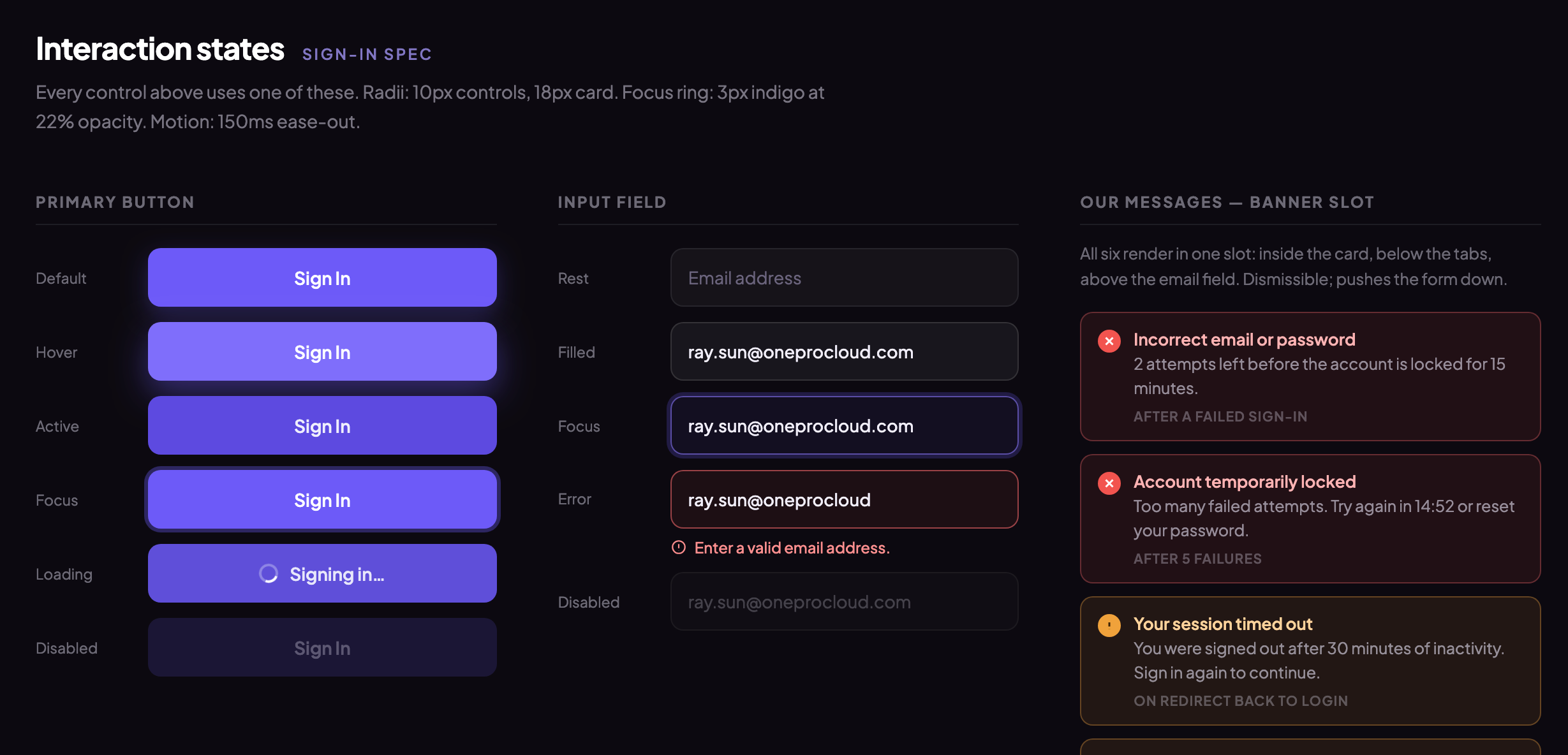
The design works through interaction states instead of stopping at the default screen.
That distinction matters. A polished page is one thing; a usable product is another. In my experience, Claude Design sometimes produces solutions more complete than those I’ve seen from established designers, with thoughtful touches I hadn’t considered myself.
Different Rhythms, Similar Code
Codex feels more like an engineer: give it a task, and it tends to get moving, produce a working version, and iterate from there. Claude Code is more likely to talk through the goal, the constraints, and the approach before it starts.
The final code may not differ much. The real difference is the pace of the work. Codex moves quickly; Claude Code spends more time making sure the direction is right.
In AI-assisted development, writing code is often the cheap part. Going down the wrong path and then redoing the work is expensive. That’s why I’ve come to value Claude Code’s upfront thinking for a new module, a redesign, or a substantial refactor. Once the direction is clear, Codex is excellent at carrying the implementation forward.
The Combination That Works for Me Right Now
For now, a practical division of labor is to use Claude Code as the designer and Codex as the developer.
I can use Claude Design to work out the page structure, states, interactions, and rationale, then hand the result to Codex to implement. This works particularly well in an existing project: Claude Design can study the current code and shape the UI redesign, while Codex makes it fit the existing architecture.
Still, if my account were working and I had enough subscription capacity, I wouldn’t choose to switch tools so often. Context matters in real development. Requirements, design decisions, implementation, debugging, and refactoring all build on one another. Every handoff means reconstructing that context, and some of the thinking that never made it into a written spec can get lost.
So this Claude Design–Codex pairing is a useful compromise for my current situation, not my ideal workflow.
The Judgment Is Still Ours
Whichever coding agent I use, the ceiling on the result still depends on how deeply I think about the problem. AI can accelerate execution and surface ideas I might have missed. It cannot decide for me whether I’m pursuing the right goal or making the right trade-offs.
AI should assist people, not the other way around.